
Achieving ‘happy happy’: Insights into the art of Nordic collaboration
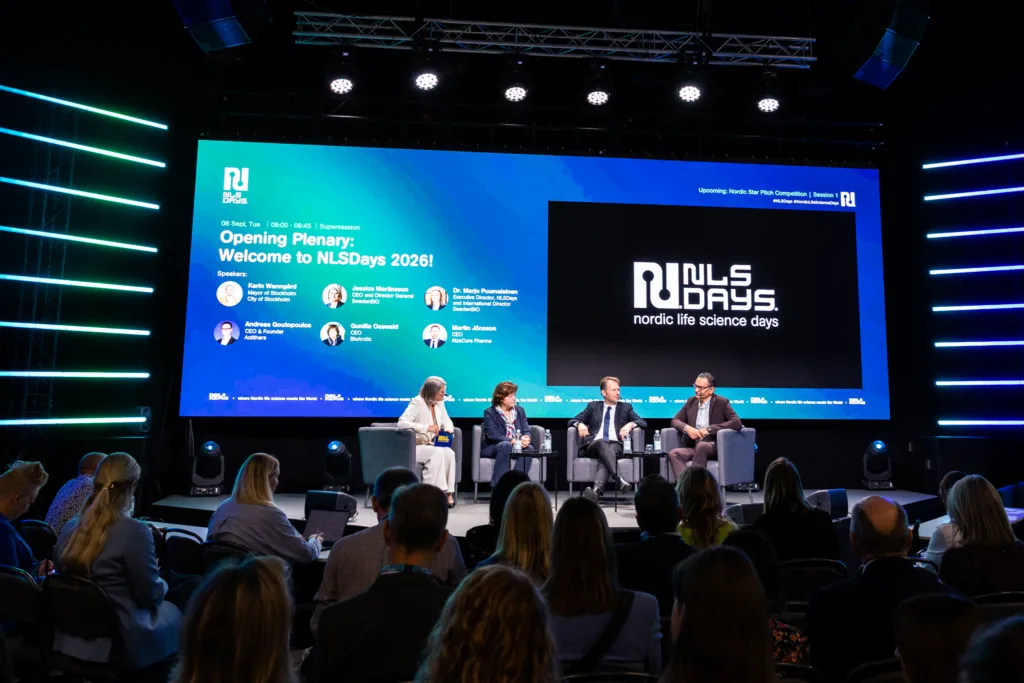
The opening panel at Nordic Life Science Days 2026 provided a rich smörgåsbord of advice on how to start, grow and thrive in one of the world’s most dynamic life sciences regions. Hosted by SwedenBIO in Kista, one of Europe’s leading tech hubs, the session was full of energy and positivity about the way in which the Nordics are growing through collaboration and generating innovations for a better future.
By Scius Communications
Here, as Stockholm’s Mayor Karin Wanngård said with flair, great ideas meet great investment and great expertise, enabling companies to grow and for their transformative ideas to reach the world, converting science into impact. Sweden’s capital city, described as the ‘capital of Scandinavia’, has an aspirational slogan, ‘from Nobel to NASDAQ’.
Collaborations are essential to achieve this ambition and successful collaborations are built by bridging different perspectives. Karin remarked on the physical bridges between the world-famous Karolinska Institutet and Karolinska University Hospital. NLSDays facilitates the bridges between ideas and applications, science and business to deliver powerful impact.
The three biotech CEO panellists of the opening session, discussed with the panel moderator, SwedenBIO’s CEO Jessica Martinsson, what it takes to build and grow a successful biotech businesses. Firstly BioArctic CEO, Gunilla Osswald, talked about her decades-long experience of building trust in partnerships to grow an innovative drug development and platform company. BioArctic is focused on neurodegenerative disorders and central nervous system conditions, using selective antibodies to target toxic, misfolded protein aggregates before they cause nerve cell death.
Gunilla expanded on what makes for successful collaborations and described it as simple normal leadership which means having one agreed vision, clear goals to achieve that vision, with both parties collaborating as one team, working with clear roles and responsibilities. Listen to the other party, understand what’s important for them, and say what’s important to you, she said. This alliance management approach should strive to reach a ‘happy happy’ stage.
BioArctic was founded over two decades ago with soft money from grants providing significant support. The company was just 20 people when Gunilla joined. The pivotal moment came in 2018, when highly consistent Phase 2b data provided confidence that lecanemab—now marketed as Leqembi—could reach patients. Developed through BioArctic’s long-standing collaboration with Eisai, it received US approval in 2023.
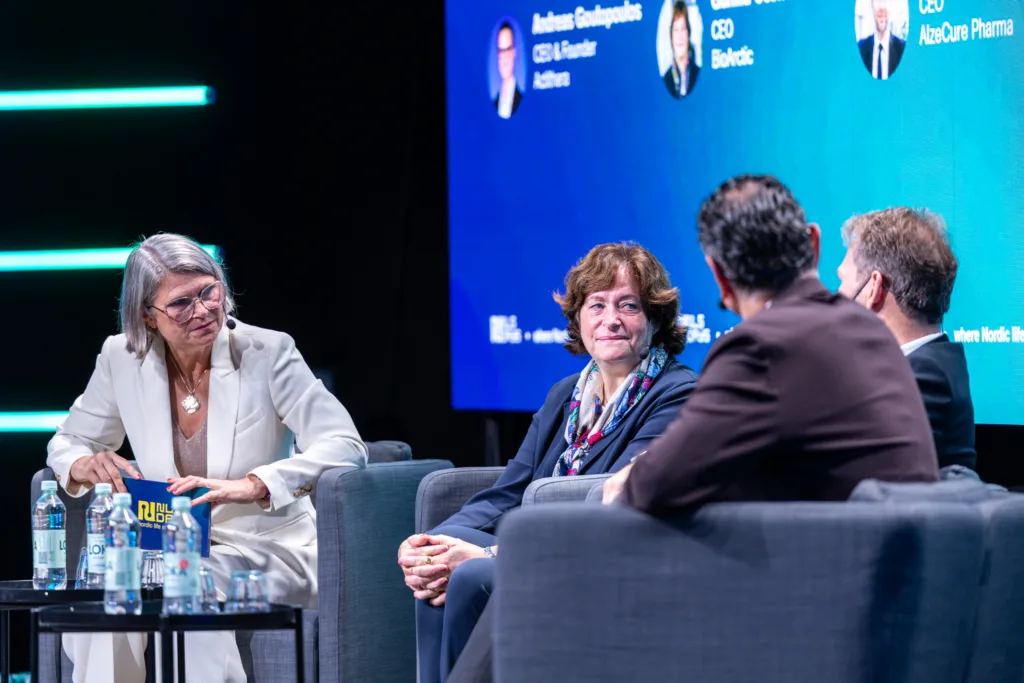
Pharma collaborations helped BioArtic build its pipeline. The company is also expanding its BrainTransporter technology into new areas, including genetic medicines such as oligonucleotides and RNA. This determined pursuit of innovation over the decades, with two different business models, developing and partnering its own drug programmes while also applying its BrainTransporter technology to partners molecules, has enabled the company to achieve a good financial situation, with more than SEK2 billion in cash, and a team that has now grown to 170. This is an excellent case study of the phenomenal potential that resides in the Nordic life sciences industry.
Another case study to take the stage was AlzeCure Pharma, based in Flemingsberg, also focused on neurodegenerative diseases. The Company’s CEO, Martin Jönsson, spoke about how the company, a spin-out of AstraZeneca, has focused on developing first-in-class, and best-in-class small molecules, designed to counteract re-accumulation of harmful amyloid in the brain.
Out-licensing two of the company’s Alzheimer’s assets has fuelled the road to success. Firstly, with a major deal with Lilly worth over $1 billion, spread across multiple clinical and commercial milestones, which grants global rights to Alzstatin ACD680. Secondly, a deal with a smaller company in Denmark, QuantumCell ApS, backed by top-tier investors including Novo Holdings, the Lundbeck Foundation, and Forbion. This agreement has a potential deal value of $2.2 billion, including a $12 million upfront and an investment in AlzeCure, for the global rights to the company’s Alzheimer’s platform NeuroRestore, including its leading drug candidate ACD856. Martin said it helped that the investors were very active in the due-diligence process.
Alzheimer’s is a hard therapeutic area to work in, with several companies leaving the space, and to succeed you need great data and a great team, but also the determination not to give up, to stick at it and pull together. It is an approach that might be described in Finland as ‘sisu’: perseverance in the face of a difficult and protracted challenge.
Actithera’s CEO Andreas Goutopoulos took the stage to describe the Company’s journey to becoming a well-financed 25-person radiopharmaceutical company. He left a 25-year career in pharmaceutical drug discovery to establish Actithera, initially as a very small US-based company. Strong data enabled the company to attract an initial Nordic investor, Hadean Ventures, who conducted deep diligence and provided the first term sheet. That attracted other investors, enabling Actithera to close an impressively oversubscribed $75.5 million Series A in July 2025, securing a syndicate of nine investors.
Money secured, the company looked to expand and Andreas quickly found that Norway’s capital, Oslo, has a fantastic ecosystem in radiotherapeutics, with big pharma companies such as Bayer, top hospitals, and CROs all within 5 km of each other, in a cost-effective ecosystem, full of excellent expertise. All this made Oslo a compelling location to set up the company’s headquarters and R&D operations and Andreas and team were able to quickly move into lab space. This very positive Nordic experience means Actithera has quickly grown to a company with 25 people and is poised to transition to clinical-stage company.
Andreas remarked, with his US perspective, that what’s attractive to international investors about the Nordics is that there is a disproportionately high level of innovation, despite a relatively small population. This is due to the region’s fantastic education system producing a highly educated population. Plus, the Nordics are very cost efficient, adept at stretching their money, so while the costs of innovation are lower, the quality absolutely is not.
It’s clearly well worth checking out what the Nordics have to offer on the path from Nobel to NASDAQ. Next years’ premier Nordic life sciences event will be held in Copenhagen. Join us here to discover the spirit of Nordic collaboration for yourself.