
How Europe can turn great science into global companies, and the Nordics’ role
Europe excels at science, clinical expertise and public research funding, yet too many European innovations are commercialised, financed and scaled elsewhere. From 2028, the EU will shift its support from rewarding scientific excellence towards rewarding growth and competitiveness, a new ball game that will affect the whole sector.
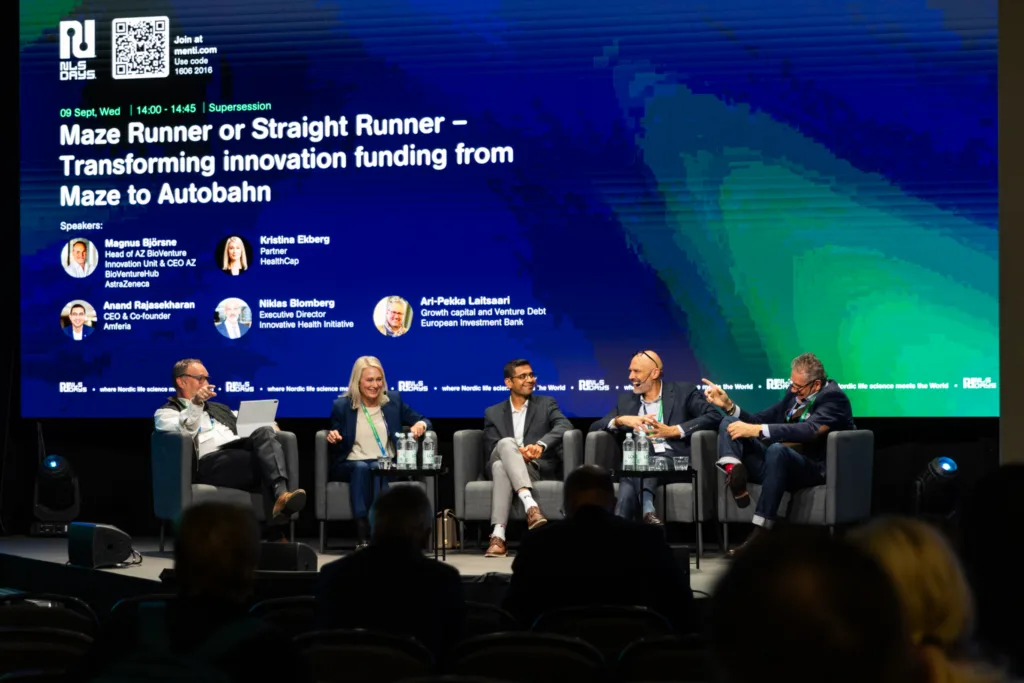
A super session at NLSDays 2026 asked what needs to change for Europe to fix the “missing middle” between research and market. Moderated by Magnus Björsne, Head of the AZ BioVenture Innovation Unit and CEO of AZ BioVentureHub at AstraZeneca, the panel featured Niklas Blomberg, Executive Director of the Innovative Health Initiative (IHI); Ari-Pekka Laitsaari, Growth Capital and Venture Debt at the European Investment Bank; Kristina Ekberg, Partner at HealthCap, who also represents the Coalition for Life Sciences; and Anand Rajasekharan, CEO and Co-founder of Amferia.
Björsne opened with a paradox: Sweden and the Nordics rank at the top for innovation, yet lag behind when it comes to converting that innovation into globally scalable companies. Asked to name the single biggest structural barrier, the panellists pointed in different directions. “It’s not a lack of science, and it’s not the deal flow. It’s the lack of capital, and we need to see the private capital stepping forward,” Ekberg said.
Laitsaari argued that too little attention is paid to people. “Scientists and founders are the essence of it all, but they do not hold the sacred keys to take the company to the next level,” he said, stressing the need to attract experienced leaders who have built companies before.
For Rajasekharan, the problem was regulatory clarity. When the EU’s Medical Device Regulation came into force in 2021, he described the situation as “utter chaos”. Amferia, which develops new technologies for wound care and was recently granted FDA De Novo classification, turned its focus to the US instead. “The European ecosystem was actually an enabler, unfortunately, for us to go into the US rather than focus on Europe,” he said. “One meeting with the FDA gave us really good clarity on what they wanted and what they expected from us.”
“No one is going to fund you if you don’t have a clear way of attacking that problem.” – Anand Rajasekharan, Amferia
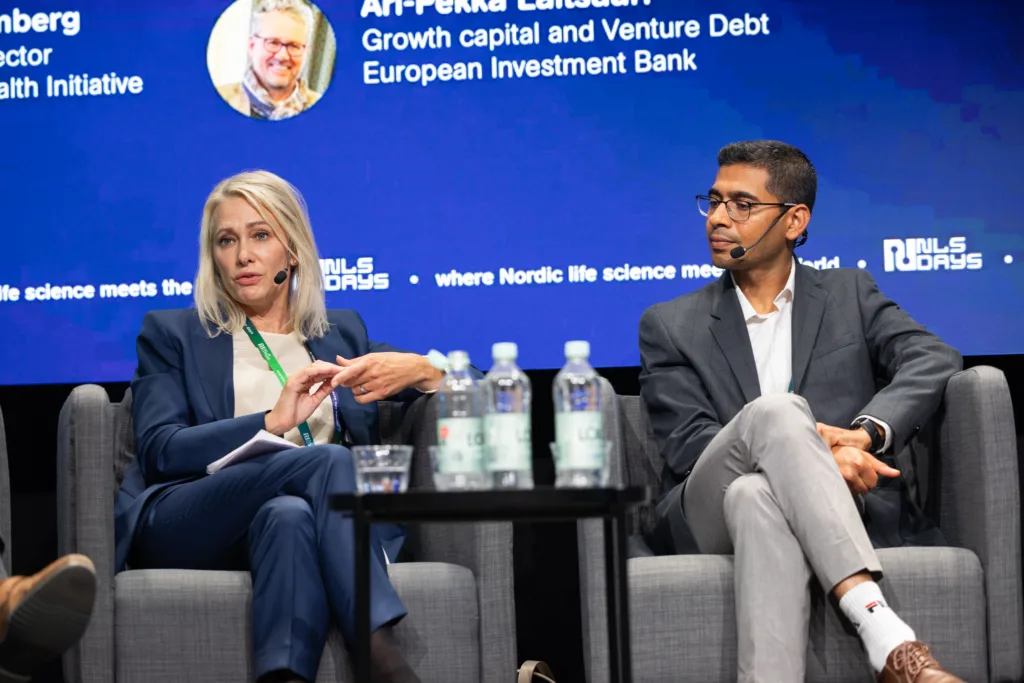
The challenge does not end with a CE mark, Rajasekharan added. Reimbursement differs between every European country, and in Sweden companies must approach each region separately. “No one is going to fund you if you don’t have a clear way of attacking that problem.”
Blomberg agreed that Europe is not yet good at turning collaborative research into product companies. “We do scientific excellence really well,” he said, but the step towards transformative scale is missing in life science, even though it has been achieved in areas such as microelectronics. He noted that the EU’s new Biotech Act and life science strategy address regulation, clinical trials and investment, but largely miss the path into healthcare systems. “It doesn’t necessarily need new regulation. It might just need better implementation and better harmonisation between the regions that are procuring.”
On financing, Laitsaari described the EIB’s role as going into the risk space where venture capitalists cannot go, and emphasised that every company follows its own trajectory. Ekberg warned that the proposed European Competitiveness Fund must make a real difference: “It would be a huge failure if it’s just another public funding layer.” She stressed that the fund needs a substantial equity component and a sufficiently large healthcare pillar, and that public money cannot carry the sector alone. “We need to crowd in the private capital.”
Could the Nordics act as a test bed for Europe, implementing in two years what might take five at EU level? Laitsaari pointed to Denmark’s track record of producing strong life science companies time after time. “Sweden is underrepresented in our portfolio,” he admitted. “It is for me to correct that.”
When Björsne asked whether Nordic governments could act as first customers for validated health innovations, Rajasekharan called for a well-thought-through strategy rather than one size fits all. “The home market needs to take that responsibility in taking that risk,” he said.