
Is CNS entering a new era? Nordic experts weigh breakthroughs, biomarkers and brain shuttles
Drug development for the central nervous system has long been one of the toughest areas in life science. At NLSDays 2026, a panel of biotech leaders, investors and pharma representatives discussed whether better biology, sharper biomarkers and record deal-making mean that CNS has finally turned a corner.
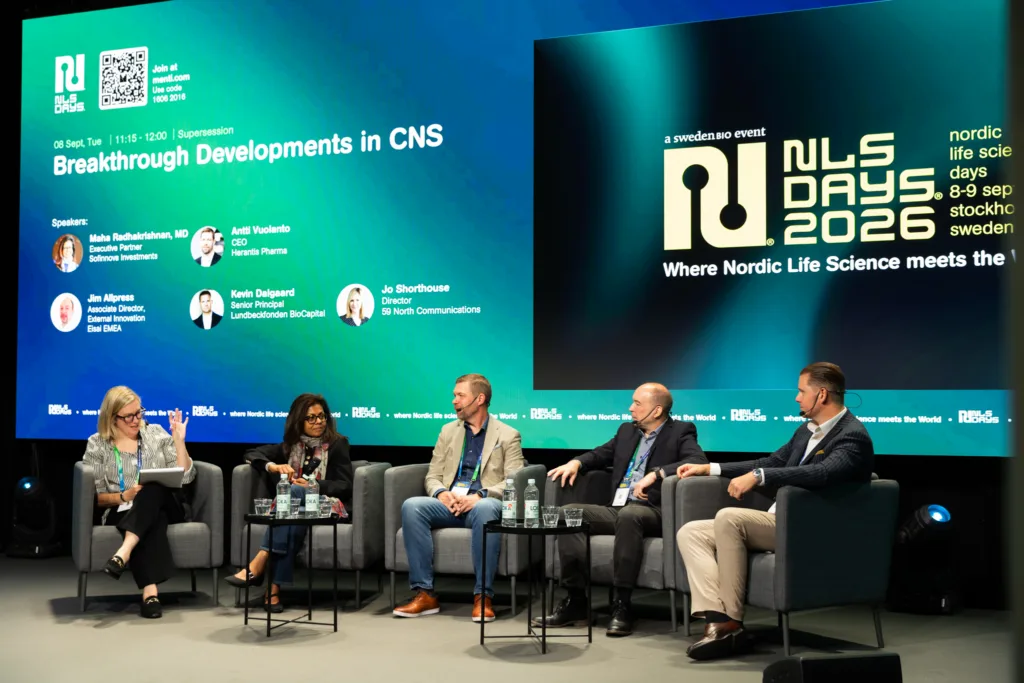
Jo Shorthouse, Director at 59 North Communications, moderated the supersession “Breakthrough Developments in CNS”. She opened by reminding the audience why the field is so hard: the biology is complex, patients are heterogeneous, trials are long, and it is difficult to show that a drug does what it should in the brain. Yet investment tells a different story. In the first nine months of 2026, the ten largest CNS transactions had a combined value of $28 billion.
“That level of investment we just wouldn’t have seen 10 or 15 years ago,” Shorthouse said.
For Maha Radhakrishnan, MD, Executive Partner at Sofinnova Investments, the biggest shift is how diseases are diagnosed. The field has moved from syndrome-based diagnoses to identifying the molecular pathology behind them. The Alzheimer’s drugs lecanemab and donanemab show what is possible when patients are selected based on amyloid rather than symptoms alone. The ALS drug tofersen showed that neurofilament light could serve as a surrogate biomarker.
“Are we where precision oncology is sitting today? No. But have we come a long way? Most certainly,” she said.

Antti Vuolanto, CEO of Herantis Pharma, pointed to a change in how biotechs move from preclinical work into the clinic. “Earlier, you had an animal study, showed efficacy and continued into clinical development,” he explained. “Now you need to really understand what your animal model is, how it mimics the human disease and what biomarker profile you might see.” That path is long and expensive, he added, but “the heart of it is the science”.
Kevin Dalgaard, Senior Principal at Lundbeckfonden BioCapital, warned against lumping three things together: whether the probability of technical success has increased, whether payers and regulators reward CNS drugs that work, and whether capital has become cheaper. “When people talk about a new era, they tend to focus on the second and third, but that does not really change the underlying biology,” he said. “If you confuse those, there is a real risk that you pay too high a price at the wrong point in the cycle.”
Consistent results from different companies targeting the same mechanism are one sign that the odds are improving, he said. Still, the likelihood of approval in CNS remains very low.
Jim Allpress, Associate Director, External Innovation at Eisai EMEA, said that Eisai’s threshold for partnering has always been low. He pointed to the company’s collaboration with BioArctic, which began more than 25 years ago, long before the amyloid hypothesis had any clinical proof. What has changed is the ability to value early opportunities. Human genetics (GWAS) and better models based on human stem cells (iPSCs) now give partners more confidence.
The panel turned to what it takes for a small Nordic biotech to bring a CNS innovation to the world. For Allpress, excellent science is the baseline, but culture and trust are just as important.
“Be upfront about the issues. Here is the problem, here is the mitigation. If you have the right culture, you can build that trust.”
Vuolanto noted that BioArctic engaged with pharma very early. Companies working with entirely new mechanisms face a higher burden of proof. “For a biotech, the biggest hurdle is how you get financed,” he said, “and the best validation comes from pharma or specialist investors.”
Radhakrishnan answered “yes and no”. Investors are more open where there are validated precedents, such as the muscarinic class after the approval of Cobenfi in schizophrenia. Completely new biology is a different matter. “In CNS, translatability is not a given,” she said. Sometimes she prefers to wait for clinical proof-of-concept data before investing.
Dalgaard was more optimistic. When human genetics defines both the target and the patient population, investors like it and often back it. And today the biology can be measured. “We can measure CSF exposure, receptor occupancy and neurofilament light,” he said. “We can now get answers to questions that used to be reserved for big phase 3 trials.” He compared it to cardiometabolism, which a decade ago was off-limits to venture capital.
Vuolanto said companies have to work with the biology they know. “If you want to be a unicorn, you need to invent something new, and that means new biology.”
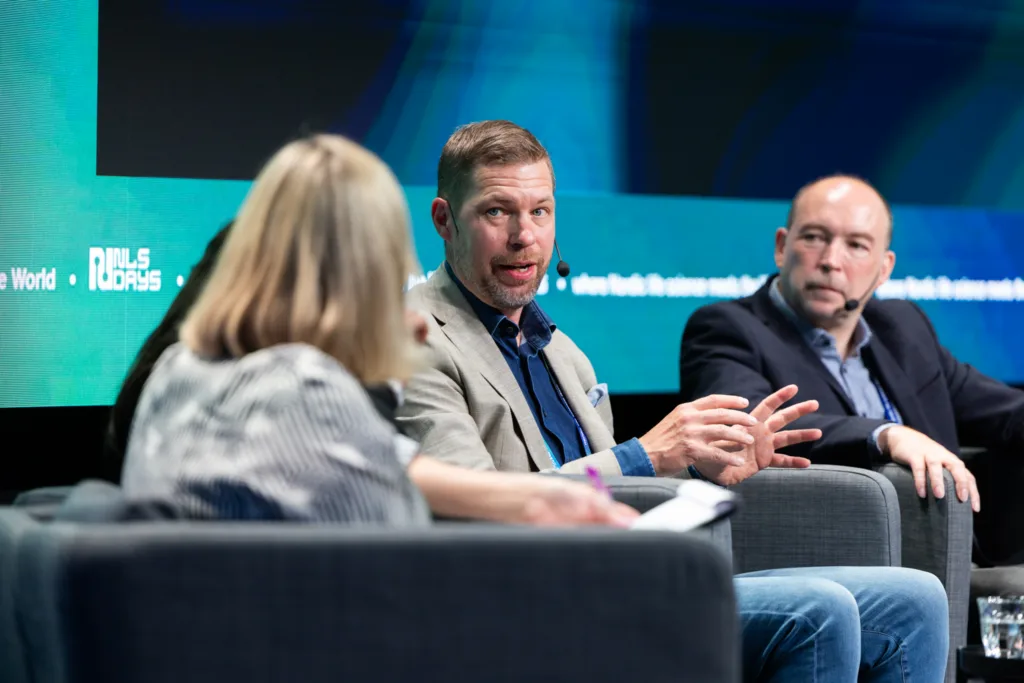
Radhakrishnan listed a wide range of areas with major unmet needs:
- Neurodegeneration: ALS, Huntington’s, Parkinson’s and the tauopathies.
- Neuromuscular diseases: DMD, DM1 and FSHD.
- Neuropsychiatry: the negative symptoms of schizophrenia, depression, PTSD and anxiety disorders.
“Shift away from symptomatic approaches, look at the biology of the disease and use biomarkers.”
She wants biomarkers for diagnosis, prognosis, target engagement and safety. Digital biomarkers for speech and movement are already being used in ALS. She also stressed execution: “Placebo responses are very high in neuropsychiatry. Diagnosis is just the beginning of the journey.”
Asked which development they were most excited about over the next five years, Dalgaard and Radhakrishnan both picked brain shuttles, which help drugs cross the blood-brain barrier. Radhakrishnan also highlighted PROTACs and molecular glues, which can act inside the cell. Allpress surprised the audience with non-invasive brain modulation: “We’ve been battling the blood-brain barrier for decades. Maybe physics has the answer.” Vuolanto backed his own team: “I really believe our programme could be the game changer.”
For early-stage biotechs, Dalgaard named neuropsychiatry and epilepsy as indications that are becoming increasingly attractive. Radhakrishnan added that the most promising paths may come from dividing epilepsy and ALS into subpopulations, each with the right biomarkers.