
Where investors see opportunity in healthtech–and why the Nordics are on the radar
Healthcare systems are under pressure from rising costs, staff shortages and an ageing population, and investors increasingly see healthtech as part of the solution. But as AI reshapes the landscape at record speed, telling real opportunity from hype has never been harder.
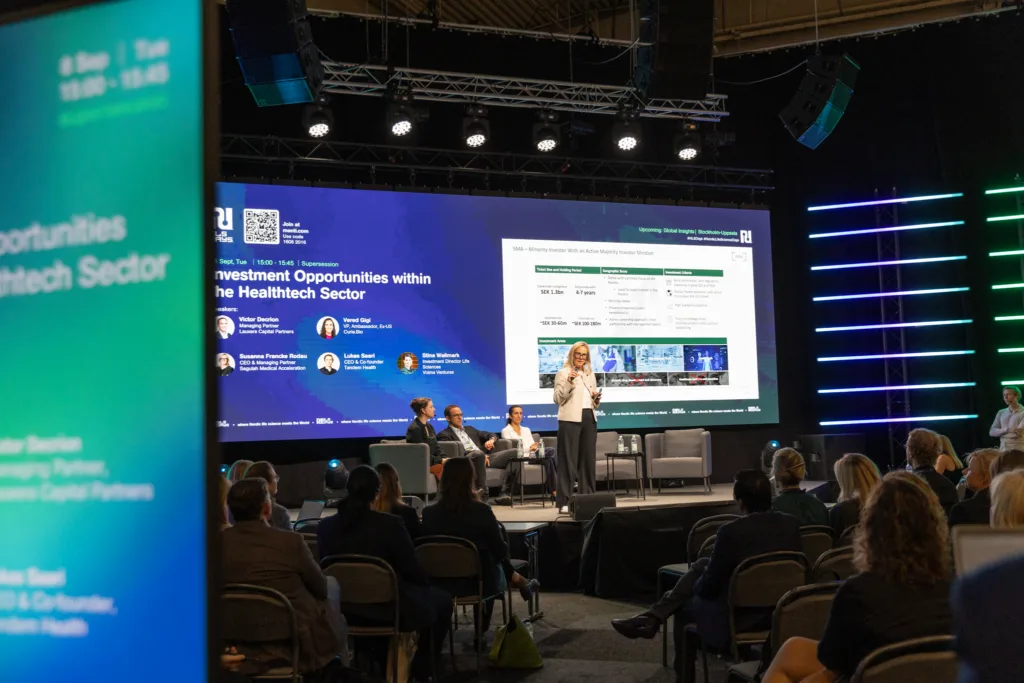
A super session at NLSDays 2026, titled: “Investment Opportunities within the Healthtech Sector” brought together investors and an entrepreneur to discuss where the strongest potential lies. Moderated by Stina Wallmark, Investment Director, Life Sciences at Voima Ventures, the panel featured Victor Decrion, Managing Partner at Lauxera Capital Partners; Vered Gigi, VP and Ambassador Ex-US at Curie.Bio; Susanna Francke Rodau, CEO and Managing Partner at Segulah Medical Acceleration; and Lukas Saari, CEO and Co-Founder of Tandem Health.
The panel covered a wide range of investment strategies. Paris- and San Francisco-based Lauxera invests in growth-stage healthtech and has already made three Swedish investments, including Natural Cycles and BioLamina. “There is lots of innovation in Europe, lots of patents, lots of high-potential scientists,” Decrion said, noting that most large healthtech players are still American because European companies struggle to scale commercially.
Curie.Bio, by contrast, invests only in therapeutics and supports its companies with an in-house team of around 110 drug developers. It has no Nordic investment yet, which it hopes to change. “We’re okay failing on biology, something we didn’t understand. We’re not okay failing on execution,” Gigi explained.
Stockholm-based Segulah Medical Acceleration invests globally in early commercial medtech and is backed by a scientific advisory board that includes current and former members of the Nobel Committee.
The panellists agreed that a strong return on investment for the customer and a short sales cycle matter more than technology alone. “If my innovation is great but it’s going to take me four years to sell it and two years to implement, then probably the investment case is less robust,” Decrion said. He pointed to AI note-taking and AI in radiology as areas with immediate impact.
“What we’re looking for is something where a doctor will say: I can never go back to the way I worked before.”
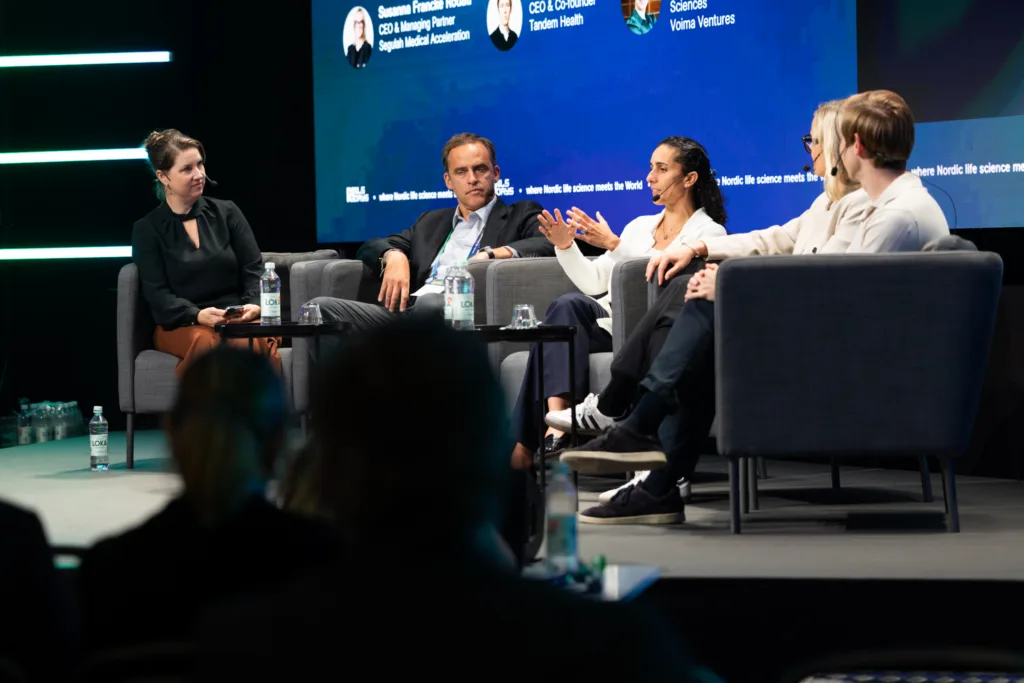
For Francke Rodau, it all starts with an unmet medical need. “Many people say that it takes 17 years before 80 percent of healthcare uses an innovation. As investors, it’s our job to make sure that we’re not part of that,” she said. She added that the real test is whether a product is a need-to-have rather than a nice-to-have: “What we’re looking for is something where a doctor will say: I can never go back to the way I worked before.”
Saari, whose AI medical assistant now serves more than 10,000 care organisations across Europe, described the criteria Tandem Health used when founding the company: start in admin rather than clinical work, build on top of existing systems, and require limited change management. “The overhyped ones are these very niche AI use cases,” he said.
Several of the panellists warned against leading with AI. “It can’t be a feature,” Gigi said. “If it’s just a feature, someone next Thursday is going to come with a new feature.” She compared AI to a PCR machine in a lab: “It’s not a matter of if anymore. It’s just how we do it better, and where and when to use it.”
Francke Rodau noted that a strong AI profile tends to attract generalist investors who may lack the patience the sector needs. Saari offered a different view. “The generalist investors just move ten times quicker and with much more conviction,” he said, explaining that Tandem’s latest rounds went from first discussion to signed term sheet in less than two weeks.
For Tandem Health, Europe’s complex regulatory environment has become a strength. “You can either shy away from it because it’s difficult and complex, or you can embrace the complexity and see that we can make this a competitive difference,” Saari said. With harmonised rules such as GDPR, the Medical Device Regulation and the AI Act, a company active across Europe gains economies of scale and builds a moat that is hard for American competitors to cross.
When it comes to medtech, both Francke Rodau and Decrion want to see commercial traction before investing. “Innovation doesn’t necessarily translate into market share. In the end, the market is right,” Decrion said. He described how OrganOx, a Lauxera portfolio company, rapidly gained market share against a more complex US competitor simply because its liver transplant device was easier for hospitals to use.
Asked what is most often misunderstood between investors and founders, Gigi pointed to value inflection points: a scientific milestone, such as positive data in a mouse model, is not always one investors can raise money on. Francke Rodau highlighted founders’ tendency to underestimate the effort it takes to win commercial traction, while emphasising that investors must also listen and learn.
Decrion closed with a call for both sides to step out of their comfort zones. “We as investors need to be pro-business,” he said. “And entrepreneurs need to get out of their comfort zone, look at the data and be patient.”